Honoring Local Veterans’ Service and Sacrifice: Bill Hart’s 1948 Thunderjet Survival Story Republished
Description: SECO News republishes Bill Hart’s dramatic 1948 F-84 Thunderjet survival story to honor Southeast Colorado veterans and their service and sacrifices...

Bill Hart’s 1948 F-84 Thunderjet Escape: Pilot’s Own Account Corrects Historic Reports
BILL HART’S CORRECTIONS AND CLARIFICATIONS
Some of the information in these articles needs correction/clarification.
First, the altitude was about 300 feet and I doubt if the aircraft gained any altitude. This was according to my Flight Leader who was showing his F-84 on the ground as a static display.
Second, the airspeed was about 550 mph when I rolled out of my turn inbound so it would have been between 550 and 600 mph when my F-84 “came un-glued”.
Third, the reporters must have gotten the idea of “automatic” bailout from having seen the “CAUTION EJECTION SEAT” placard on my Leader’s F-84. We had not yet been furnished the proper parachutes for use in the ejection seats, nor had the seats been fully tested. Consequently, the explosive charges were not installed, as would otherwise have been suggested by the caution placard. The fact is, I did it the old-fashioned way, i.e., jettison canopy, release lap-belt, and pull rip-cord — this in certainly no more than a couple of seconds.
Subsequent investigation revealed design errors in all aircraft of this model — errors which caused the death of three pilots within the same week as my accident (two of these were test pilots).
- Bill Hart
ORIGINALLY PUBLISHED ON SEPTEMBER 19, 1948
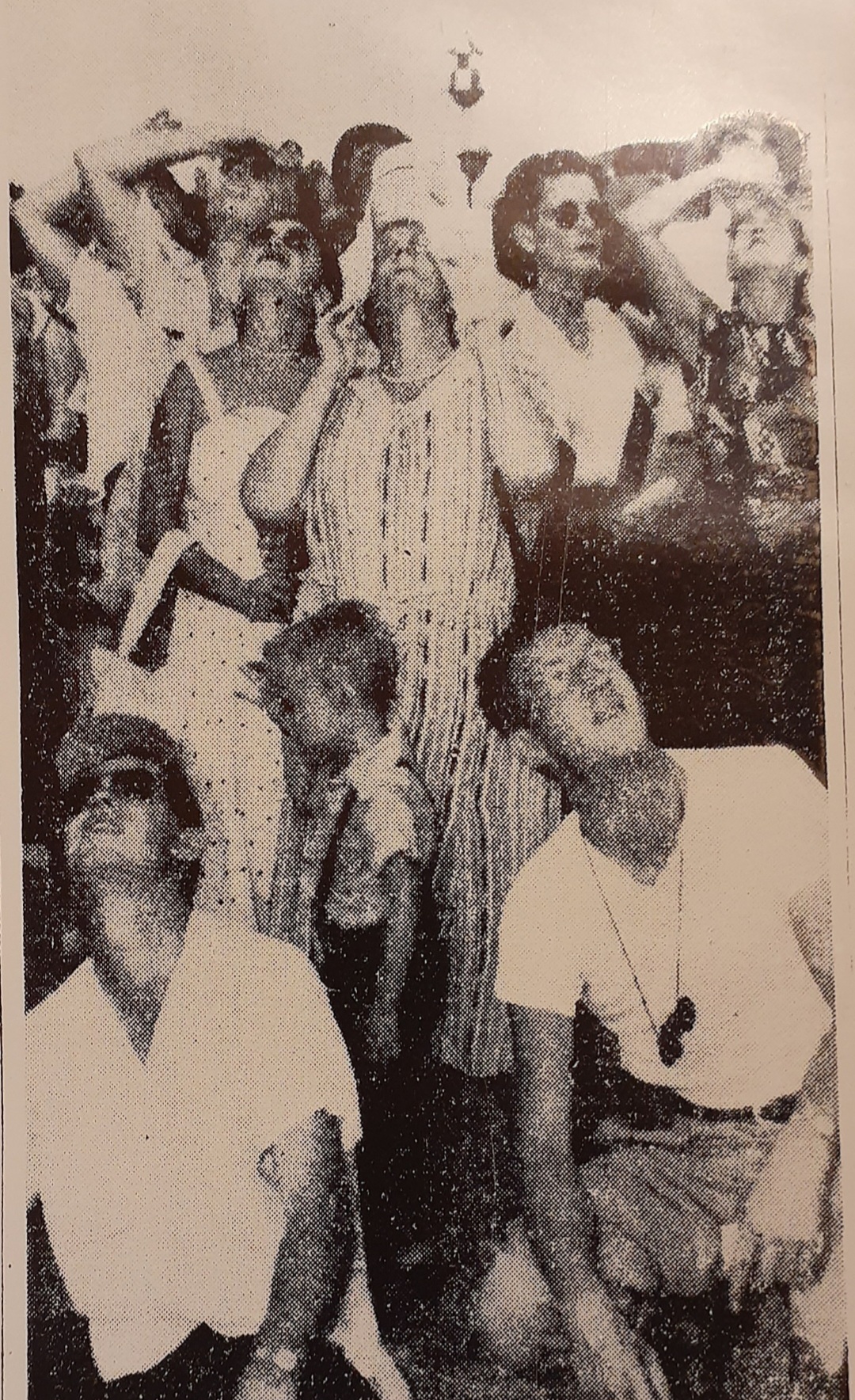
CROWD WATCHES DOOMED JET—A doomed Thunder Jet plane zooms through the air at more than 600 miles an hour as spectators look skyward moments before the plane broke apart before 15,000 spectators at Hensley Field Saturday. The pilot was catapulted out of the cockpit by an automatic ejector device and parachuted to safety in Mountain Creek Lake.
ARTICLE BY WILLIAM T. RIVES
An Air Force Thunderjet, hurtling at more than 600 miles an hour, exploded over Hensley Field Saturday before the eyes of thousands of horrified spectators.
The pilot parachuted into Mountain Creek Lake and was rescued in two minutes by a Dallas man motorboating with his son.
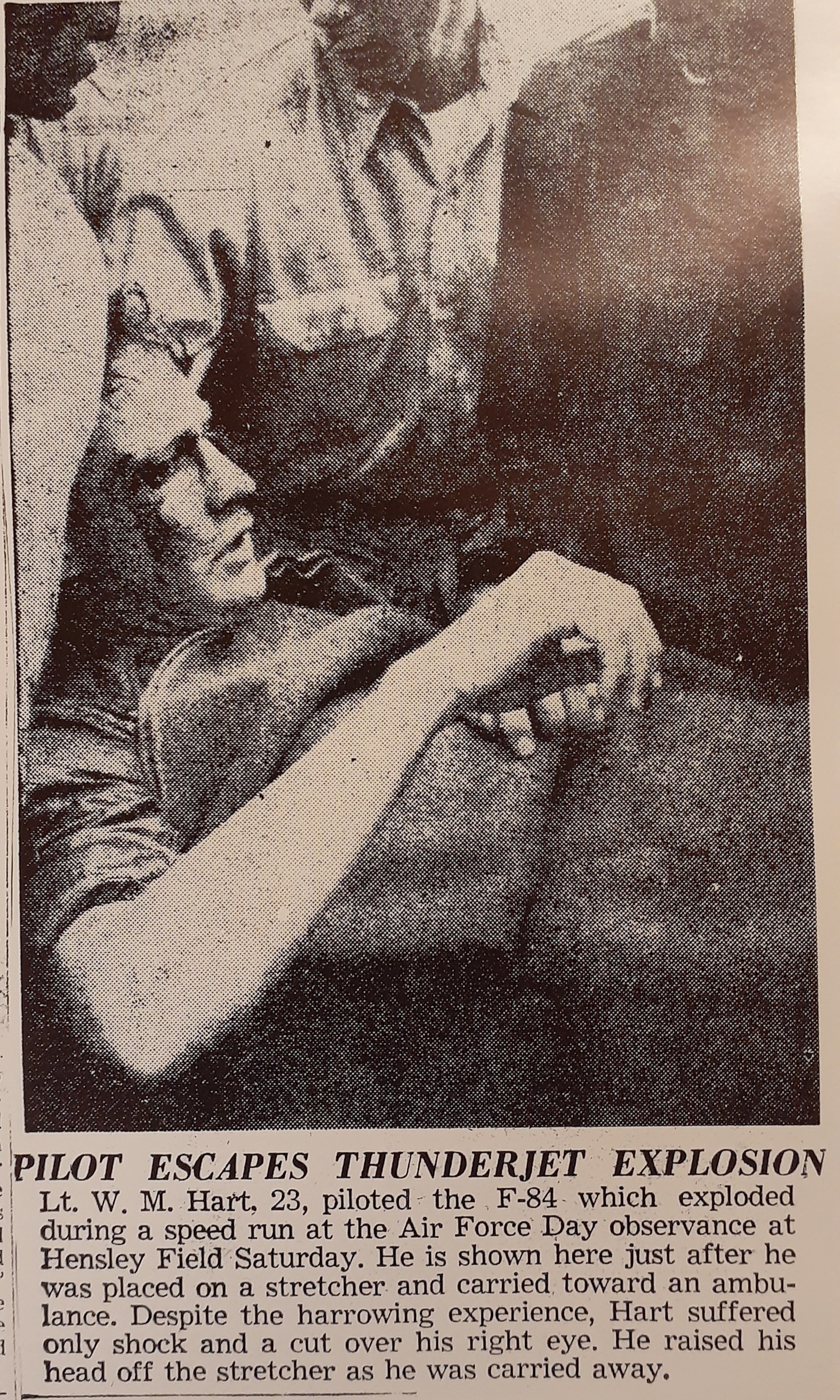
Shock and a slight cut over the right eye were the only injuries suffered by the pilot, Lt. W. M. Hart, 23, of Walker Air Force Base at Roswell, N.M.
The accident was an awesome, gripping climax to the most spectacular exhibition of air power ever seen in Dallas.
Hart’s speed flight was billed as the feature of the Air Force Day celebration here.
Estimates of the number of spectators ran from 20,000 to 100,000. Besides those crowding the flight line and milling around ground displays, other thousands sat in automobiles at the north edge of the field.
All eyes were on Hart’s plane—one of the latest and fastest Air Force models.
Hart made one pass over the field at about 400 miles an hour and circled to return.
Over the public address system came an unnecessary reminder: “Keep your eyes open for him. He’s really going to pour the coal to her this time.”
Trailing a thin, black line of smoke, the jet came into sight in the north. It sped past the spectators at an altitude of about 100 feet.
When Hart had flown about half a mile beyond the crowd, he began a shallow climb. He had pulled the plane to about 350 feet when it exploded.
The crowd screamed. A few women fainted. Pieces of the silver wreckage whirled through the air.
Then a parachute opened. The crowd roared in relief, but the shouts subsided as fear grew that the pilot might be floating dead in the ’chute.
Hart was seen to drop into the waters of Mountain Creek Lake south of the Hensley Field runways.
Air Force crash crews already had leaped into action, but J. W. Fallis and his son beat them to it.
Fallis, a brick contractor living at 1022 Zeb Street, and his 14-year-old son Kenneth were motorboating when they saw the plane disintegrate.
Within two minutes after Hart sank into the water, they had reached him and pulled him into their boat.
Hart was rushed to the Naval Air Station hospital. Two hours later, Air Force authorities were putting through a telephone call for him to his wife in Roswell, to assure her he was safe. Reporters were not allowed to talk to him.
Col. John Kenny, Hensley Field commander, ordered an investigation of the accident.
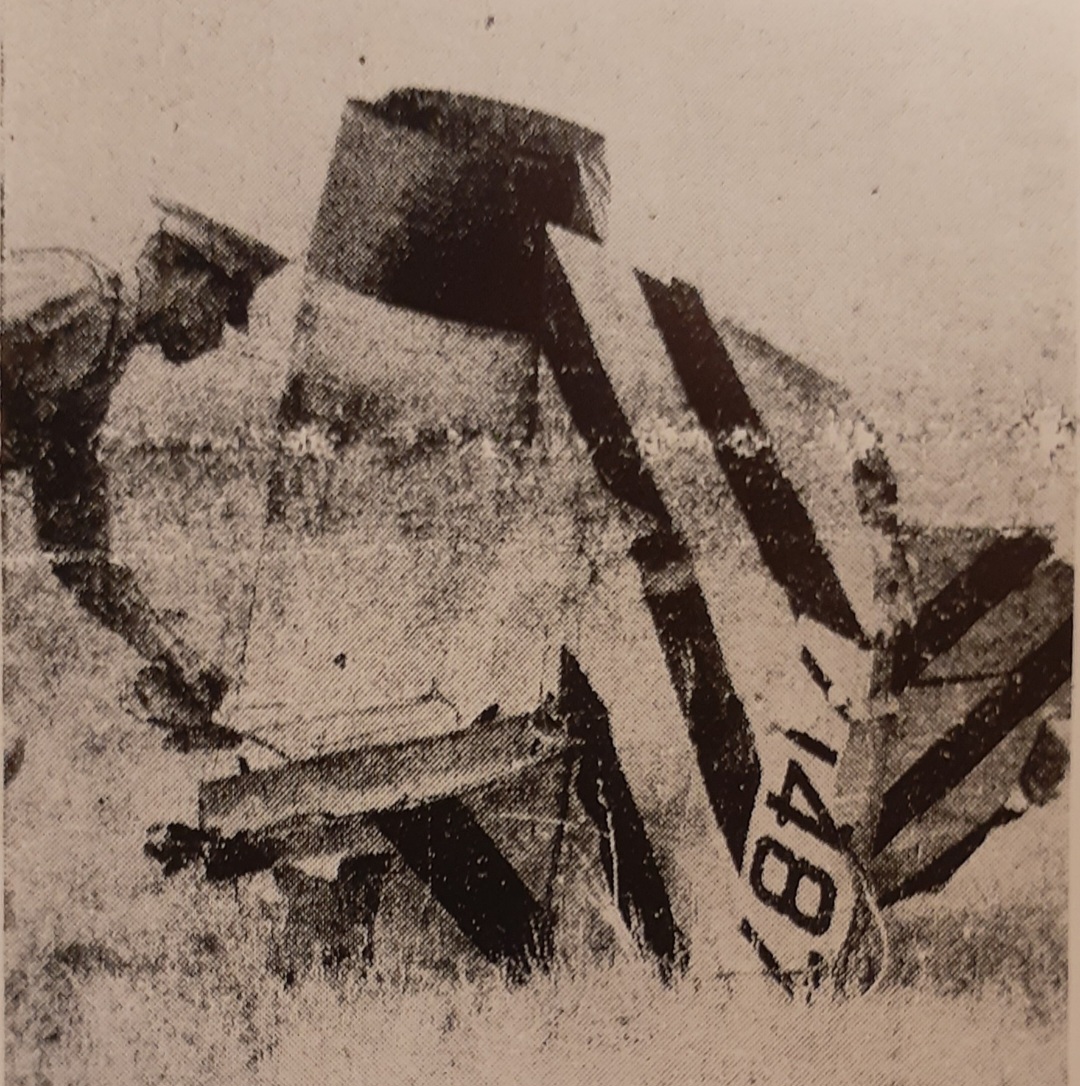
An Air Force soldier inspects the wrecked tail assembly of the F-84 Thunderjet which exploded over Hensley Field Saturday. Pieces of the shattered plane were scattered for 600 yards from the south end of the Hensley Field runways to Mountain Creek Lake.—Dallas News Photos—John Jeter.
Some officers thought that possibly the jet plane had flown into the turbulent wake of P-51 Mustangs, which had crossed the field just before the Thunderjet. When a plane runs into the flow of air from another plane’s propeller—the “prop wash”—one officer said: “It’s just as though you were in a speed boat going sixty miles an hour and ran head-on into a gigantic wave.”
Colonel Kenny did not hold to the theory that prop wash was the cause of the accident, but he would not offer an alternate idea.
Hart was ejected from the exploding plane by a device planned for use in just such emergencies. The ejector works both manually and automatically. Whether Hart worked it himself, or whether he was automatically ejected when the outside pressure reached the required intensity was not announced.
Officers of the Air Force Association, which sponsored the day-long celebration of the air arm’s forty-first birthday and its first anniversary as an independent unit of the armed services, were gratified over the show, except for the accident.
The spectators took full advantage of a varied, fascinating display, both on the ground and in the air.
At noon, two B-29 Superfortresses arrived after a 4,600-mile nonstop flight from Labrador. The pilots, Capt. H. Dean of Birmingham, Ala., and Capt. D. E. Rauscher of Salt Lake City, Utah, and their crews had been aloft 21½ hours. They showed it by their growth of beard and their tired, red eyes.
Until the air show began, the thousands of visitors milled around, peering into an F-80 jet fighter, huge commercial liners, Air Force bombers and tiny pleasure planes. Some of them, for a $2 fee, flew over Dallas for twenty minutes in a 4-engined American Airlines DC-6.
The air show kept the crowd squinting into the sky for three hours. There were parachute drops, glider tows, speed runs, dogfights, dive-bombing with live ammunition, aerobatics and pass-overs at low altitude by a massive B-36.
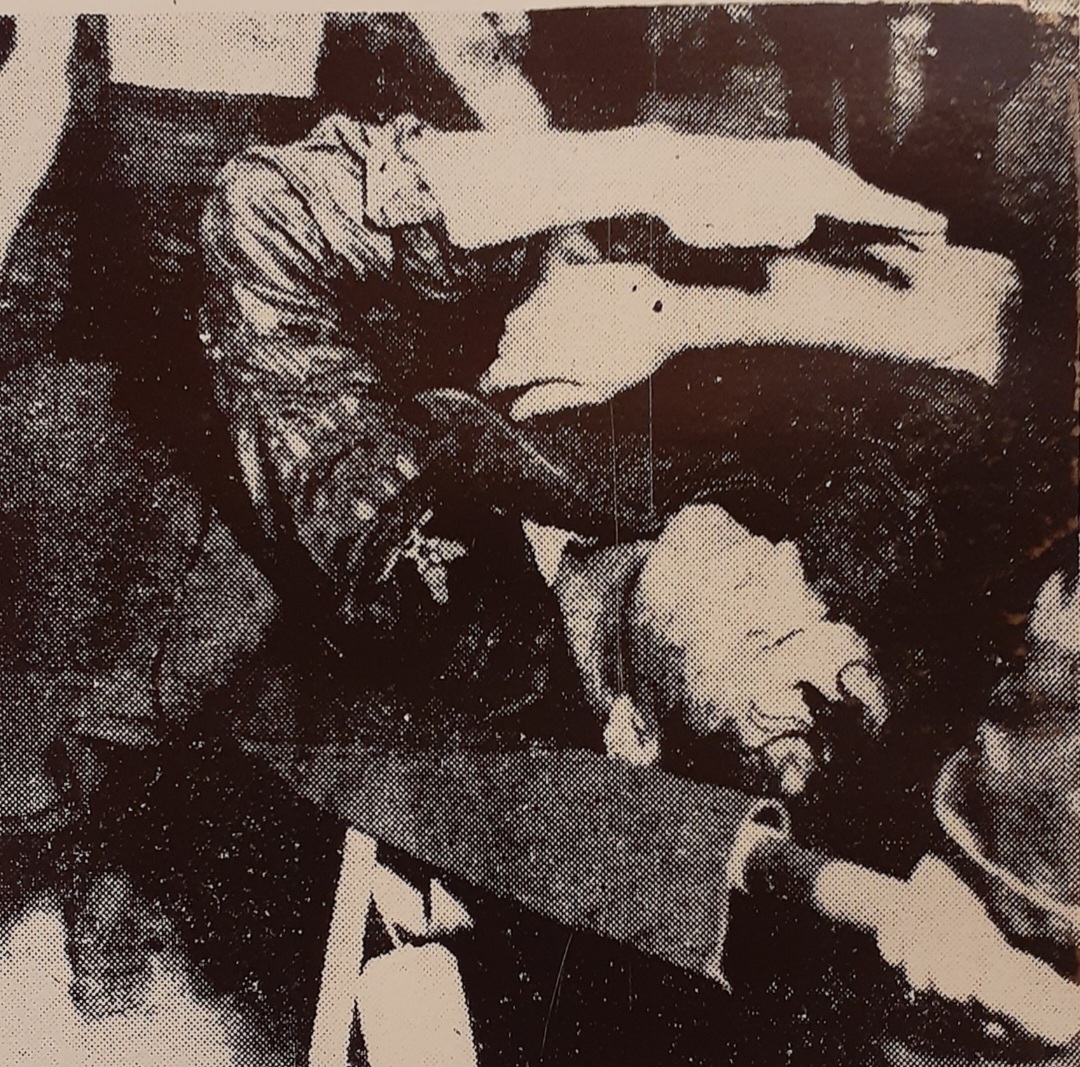
PLUCKY, LUCKY PILOT—Lt. William M. Hart, 23, was in the cockpit of a Thunderjet F-84 plane which disintegrated while flying more than 600 miles an hour at the Saturday Air Force Day show at Hensley Field. He lived to tell about it—later. Photo shows pilot on a stretcher. He was rescued after parachuting to safety in nearby Mountain Creek Lake. Hart suffered only a superficial cut above the right eyebrow.
JET BLOWS UP, PILOT PARACHUTES
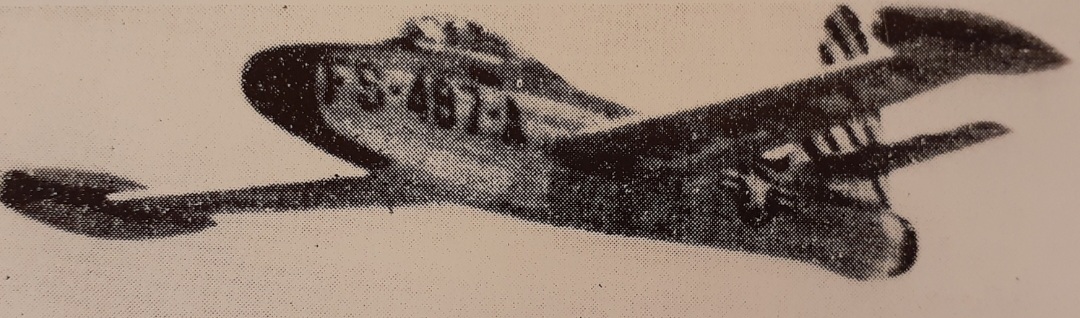
Uncle Sam’s mighty show of aerial strength at Saturday’s Air Force Day show at Hensley Field, had a dramatic and near-fatal climax, when one of the Army’s newest jet planes, an F-84, disintegrated while flying more than 600 miles an hour, but the pilot parachuted to safety.
Upward of 15,000 civilian spectators, as well as generals and countless Air Force officers and enlisted personnel, saw the new model plane go to pieces during a second speed run over the field.
The pilot, Lt. William M. Hart, 23, attached to the Walker Air Force Base at Roswell, N. M., was catapulted out of the plane by an automatic ejection device.
The crack-up occurred at about 500 feet as the pilot attempted a shallow climb after his speed run past the reviewing stands.
His parachute automatically opened a second after the disintegration, amidst a mighty cheer from onlookers, and carried him to the surface of Mountain Creek Lake.
Shortly before hitting the water Lt. Hart removed his parachute harness.
J. W. Fallis, fishing from a motorboat with his son, pulled Hart out of the water and into his boat. The pilot was conscious. A Hensley Field ambulance was at the lakeside when Fallis brought the pilot ashore.
Col. John Kenney, commanding officer at Hensley Field, would not permit a Times Herald reporter to interview the pilot after he was rushed to the near-by naval base hospital.
Military aides later reported to Col. Kinney that Lieut. Hart suffered only a superficial cut above the right eyebrow. He was not in a condition of shock, aides reported.
The whole thing seemed more embarrassing than painful for Hart, who ate a big steak Saturday night at the hospital.
He told interviewers that he had borrowed the plane from his own commanding officer at Roswell, and that now he had to explain that the plane didn’t exist any more.
Brig. Gen. Harry Crutcher of the Texas Air National Guard, who talked with Hart in the hospital, found the young “miracle man” in excellent spirits, though wearing a bandage over the right eye and forehead. Crutcher visited the pilot to thank him for coming to Dallas to participate in the air show.
“I don’t want any thanks,” he told Gen. Crutcher. Referring to the plane blast from which he escaped so miraculously, he commented, “I don’t know what happened.”
Col. Kenney said he would immediately appoint a board of officers to investigate cause of the plane disintegration.
The sleek jet plane took off about 2:15 p. m., spouting vapor-smoke as it sped southward down the runway and left the ground near the lake approach.
A few minutes later Lieut. Hart zoomed in sight and past the reviewing stand at 600 miles an hour, the loud-speaker announcer said.
Some six or eight minutes later, the jet appeared in the north, headed for its second speed run. Two minutes previously three B-26 light bombers and a number of P-51’s had passed in formation, headed south.
One theory advanced was that the jet plane ran into the prop wash of the light bomber formation and broke up in the air turbulence set up by the bombers.
Lieut. Hart came on in his southward second speed run. As he shot past on a level of about 600 feet, Capt. W. B. Johnson, at the mike, announced: “Who knows—he may be doing 750 miles an hour now.”
Near the approach to the lake, the plane appeared to start a shallow climb, then instantly both wings tore off, the plane disintegrated, parts flying in all directions. Only the tail assembly was intact as it fell.
Follow SECO News on Facebook.
Subscribe to the SECO News YouTube Channel.



.jpg)


.png)













.png)